
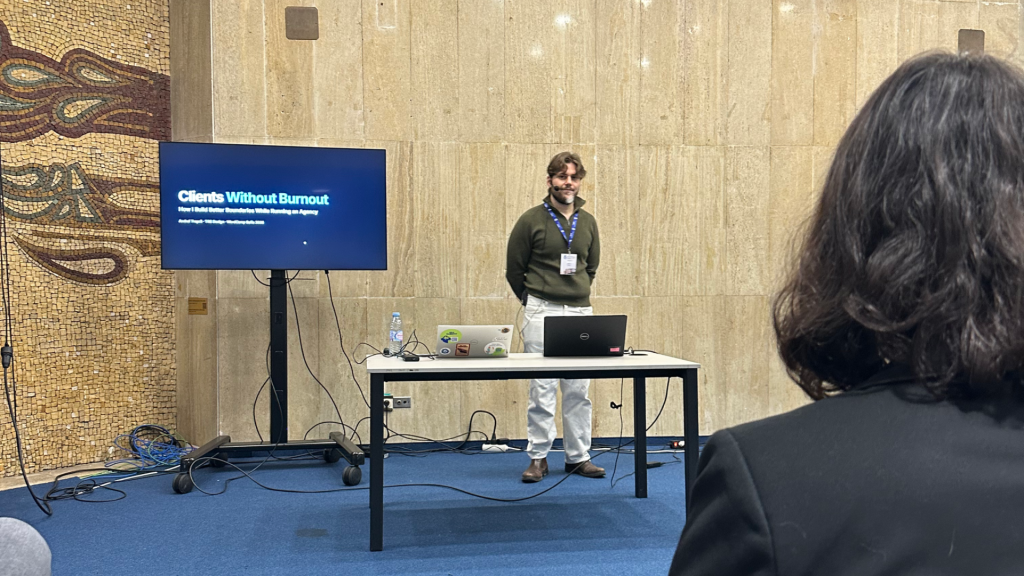
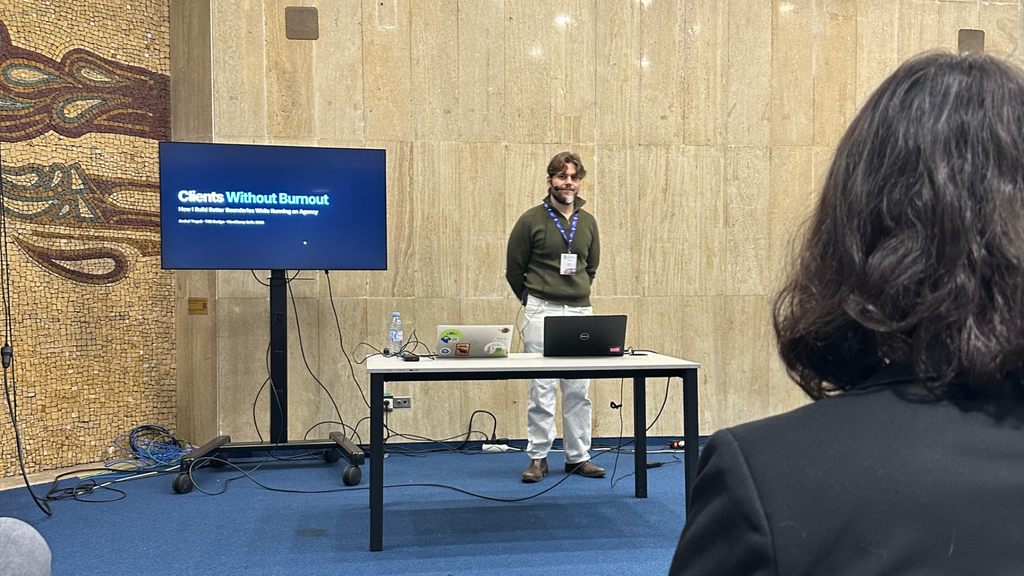
Before my talk at WordCamp Sofia, I told Mihaela that if nobody asked any questions during the Q&A, she should raise her hand and ask me something. You know, just to avoid that awkward silence when a speaker finishes their presentation and nobody has anything to say.
Well, as it turned out, we didn’t need that backup plan. Quite the opposite, actually. We ran out of time for questions and ended up continuing some of the discussions during the breaks.
But I’m getting ahead of myself. On October 24-25, I attended WordCamp Sofia 2026, my first WordCamp in Bulgaria and my second WordCamp as a speaker, following my participation in a panel discussion at WordCamp Vienna earlier this year.
I traveled with Mihaela, and besides attending the conference, we also had the chance to spend some time exploring Sofia.
Looking back, the experience exceeded my expectations. From the organization and the people we met to my presentation and my first experience contributing to WordPress Core, it turned out to be a weekend that I’m really glad we decided to be part of.
Here’s how it went.
First impressions of WordCamp Sofia
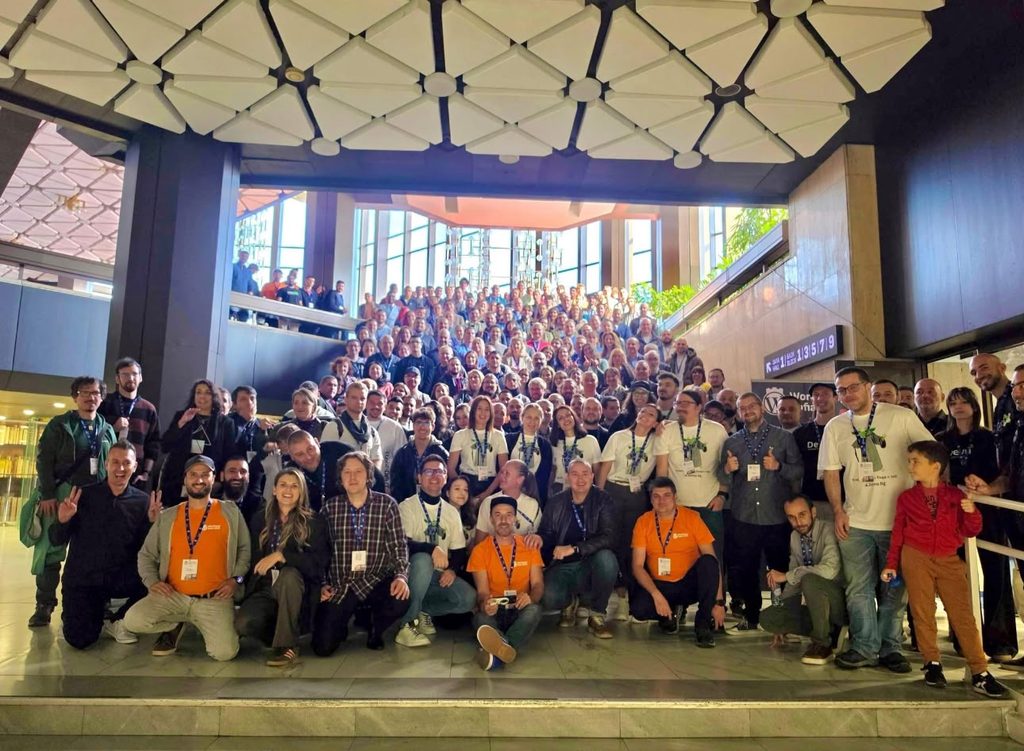
The main conference took place on Saturday, October 24, at the National Palace of Culture (NDK), one of Sofia’s most recognizable buildings.
Since this was my first time attending WordCamp Sofia, I wasn’t entirely sure what to expect. Having already experienced WordCamp Vienna, I had some idea of how these events work, but every WordCamp has its own atmosphere. ButSofia made a good impression right from the beginning.
The venue was spacious, well-equipped, and had everything needed for a comfortable conference experience. There was enough room for presentations, breaks, and conversations between sessions. But the organizing team impressed me the most.
Everyone was genuinely friendly, approachable, and ready to lend a helping hand. As a speaker, I particularly appreciated how attentive they were, not just to the practical aspects of the event but also to the speakers themselves.
They were curious about us, interested in our backgrounds and presentations, and made an effort to ensure that we felt welcome. It’s one of those things that can easily go unnoticed when everything runs smoothly, but organizing an event like this involves a tremendous amount of work, much of it happening behind the scenes. So, a big thank you to everyone who helped make WordCamp Sofia happen!
Diversity is a key aspect of WordPress
Another thing I noticed was the diversity of experience among the attendees and speakers. I met people who had been working with WordPress for considerably longer than I had. In fact, I wouldn’t be surprised if I was one of the youngest speakers at the conference.
Being surrounded by people with so much experience was both interesting and a little humbling. It’s easy to get caught up in your own projects and daily routine, but events like this remind you just how large the WordPress ecosystem really is. And how much there still is to learn.
My talk: Clients Without Burnout
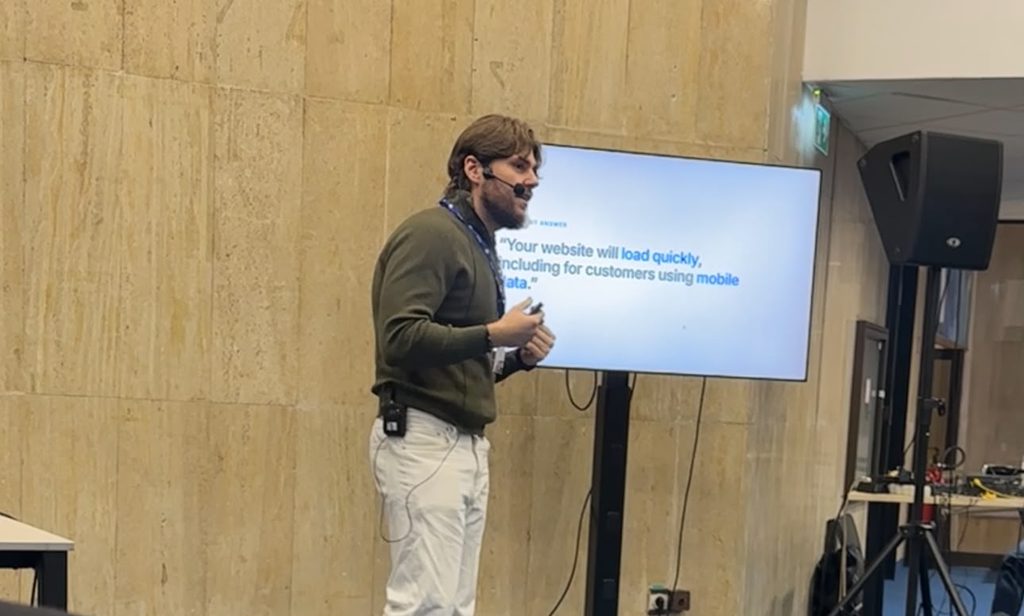
My presentation was called „Clients Without Burnout: How I Build Better Boundaries While Running an Agency.”
As someone who has been running a web agency for several years, client relationships are something I’ve had plenty of experience with. Some good experiences, some less pleasant ones, and quite a few lessons learned the hard way.
When you’re running an agency, especially in the beginning, it’s tempting to say yes to everything.
- A client needs something urgently? Sure.
- Someone sends you a message late at night? You reply.
- A project grows beyond its original scope? You try to make it work.
At first, you might even consider this a sign of good customer service. You’re being available, flexible, and helpful.
But eventually, you realize that this approach isn’t sustainable.
And that’s exactly what I wanted to discuss in Sofia: how I’ve learned to set boundaries, manage expectations, and build healthier client relationships while growing TRS Design.
I didn’t want the presentation to be a collection of generic business advice. I wanted to share practical situations I’ve encountered, mistakes I’ve made, and things we’ve changed in the way we work.
After all, there’s a difference between reading about client management and actually having to deal with difficult situations yourself.
Speaking alone versus being part of a panel
Earlier this year, I had the opportunity to participate in a panel discussion at WordCamp Vienna, where we talked about delegation, boundaries, and building sustainable businesses.
That was a great experience, but speaking at Sofia was different.
In Vienna, I shared the stage with other speakers. The conversation moved naturally between us, and there was always someone else who could contribute a different perspective.
In Sofia, I had the stage to myself. Which meant that, for roughly 25 minutes, I was responsible for keeping the audience interested.
I’ll admit that I was a little nervous beforehand. I had rehearsed the presentation several times, including in front of Mihaela, but practicing at home and standing in front of an actual audience are two very different things.
Fortunately, things went much better than I expected. Afterward, Mihaela even told me that the actual presentation was better than my rehearsals, which was particularly nice to hear.
And the audience definitely helped. There were probably around 20-25 people attending my session. Not a huge crowd, but what mattered was that they were genuinely interested in the subject.
People were paying attention, reacting to what I was saying, laughing at the occasional joke, and interacting throughout the presentation.
It felt less like delivering a lecture and more like having a conversation with a room full of people who understood the situations I was describing. That’s exactly what I had hoped for.
The Q&A that didn’t want to end
My favorite part of the entire presentation was definitely the Q&A session. As I mentioned at the beginning, I had actually asked Mihaela to prepare a question in case nobody else had one. Apparently, I had nothing to worry about.
Once the presentation ended, hands started going up, and people had plenty of questions. What I particularly enjoyed was that they weren’t just asking theoretical questions. They seemed genuinely interested in the subject, and the discussion felt relevant to their own experiences.
Unfortunately, we eventually ran out of time. But that didn’t stop the conversations. Some people approached me during the breaks, and we continued discussing the topics we hadn’t managed to cover during the official Q&A.
For me, that was probably the best feedback I could have received. Of course, it’s nice when people applaud at the end of a presentation. But knowing that something you shared made people curious enough to continue the conversation afterward feels even better.
Compared to my experience in Vienna, I also felt that the audience in Sofia was more interactive and approachable. That might have had something to do with the format. My panel in Vienna took place toward the end of the event, when people were probably getting tired, and a panel discussion creates a different dynamic anyway.
Whatever the reason, I really enjoyed the atmosphere in Sofia. And, perhaps most importantly, I left the stage feeling considerably more comfortable with public speaking than before.



Attending the other talks
Of course, WordCamp Sofia wasn’t just about my presentation. Mihaela and I also attended the English-language sessions, which covered quite a broad range of subjects.
The program included everything from WordPress development and security to artificial intelligence, content creation, and business strategy.
One of the things I appreciated was having the opportunity to hear from people approaching WordPress from different perspectives.
For example, Jordan Hlebarov discussed the relationship between Gutenberg and AI agents in „WordPress, Meet Your Agent: A Gutenberg Story,” exploring how WordPress is evolving to work with increasingly capable AI tools.
Albert Suntic also addressed AI agents, but from a different angle, discussing what developers need to consider when building products that can interact with them.
Another interesting subject was covered by Dario Jazbec Hrvatin, whose presentation, „Who Are You Writing for Anymore?”, explored how AI is changing the way people discover and consume online content.
It’s an especially relevant question nowadays, considering how much the relationship between websites, search engines, and their audiences is changing.
On the more technical side, Haim Michael discussed authentication security and the limitations of relying exclusively on web application firewalls, while Marko Heijnen explored whether we can objectively measure the quality of WordPress plugins.
And Marina Vassilyovska approached AI from a business perspective, discussing how companies can create meaningful competitive advantages when technology makes so many things easier to replicate.
WordCamp Sofia covered different aspects of WordPress
There were certainly plenty of subjects to think about.
Some sessions were quite technical, while others focused more on broader industry changes.
I generally enjoy presentations that encourage interaction and discussion, rather than simply delivering information, so I found myself particularly interested in the conversations that happened around the talks.
Still, it was nice to step away from my usual work and hear how other people are approaching problems and opportunities within the WordPress ecosystem.
There’s always value in being exposed to different perspectives, even when the subject isn’t directly connected to what you’re currently working on.
The people make the difference
One of the things I appreciate most about WordCamps is that the presentations are only part of the experience. The rest happens in the hallways, during coffee breaks, over lunch, or at the after-party.
And WordCamp Sofia was no exception. Throughout the weekend, we had the opportunity to meet some genuinely nice people.
Many had been involved with WordPress for years, contributing to the project, building products, or working in different areas of the ecosystem. I found it particularly interesting to hear about their experiences and how they became involved with WordPress.
Being among some of the younger people at the event made these conversations even more valuable.
There’s something refreshing about talking to people who have spent so much time working with the same technology but have followed completely different paths. Some of them have experience with things I’ve never worked on. Others have been through challenges that I might encounter in the future.
And sometimes, the conversations weren’t about WordPress at all. We also attended the after-party, where the atmosphere was even more relaxed.
Interestingly, most of the discussions we had there weren’t particularly work-related. We talked about personal things, got to know each other a little better, and simply enjoyed spending time together. Which, in a way, made the experience even nicer.
It’s easy to attend a professional event and spend the entire time talking about projects, technologies, or business opportunities. But getting to know the people behind those projects is just as enjoyable.
I also connected with several people on social media afterward, and I hope we’ll have the opportunity to meet again at future events.

Contributor Day: My first experience with WordPress Core
The second day of WordCamp Sofia was dedicated to contributing to WordPress. On Sunday, October 25, we headed to Puzl Coworking for Contributor Day.
For anyone unfamiliar with the concept, Contributor Day is an opportunity for members of the WordPress community to work together on improving the open-source project. And the best part: you don’t necessarily have to be a programmer to participate.
There are different teams working on different aspects of WordPress, including development, translations, accessibility, support, documentation, and more.
Since I’m a developer and genuinely enjoy programming, choosing the WordPress Core team was pretty straightforward.
I’ve been working with WordPress for years, but mostly from the perspective of someone building websites, developing solutions for clients, and running an agency.
This time, I wanted to see what happens behind the scenes. How are changes to WordPress Core discussed? How are tickets evaluated? What does the contribution process look like? And, perhaps most importantly, could I actually help improve something?
Getting started with my first Core ticket
Once we joined the Core team, some of the more experienced contributors helped us get started. I really appreciated their willingness to guide newcomers through the process.
Even though I’ve been programming for years, contributing to a large open-source project is different from working on your own codebase.
There are established conventions, existing decisions, compatibility considerations, and processes that you need to understand before making changes.
The ticket I started investigating was related to the About page in WordPress, the section that displays information about the current WordPress version and its features.
The original idea was to automate part of the version information displayed on that page, rather than updating it manually. At first glance, it sounded reasonable.
Why keep changing something manually when you could make it happen automatically?
But as I started investigating the existing implementation, I realized that things weren’t quite that simple. Introducing the proposed automation could have caused regressions and other unexpected issues. There were also considerations related to translations, additional strings, and the amount of code that would need to be changed.
I initially started exploring how to patch the behavior. However, the more I looked into it, the more I realized that implementing the automation would introduce unnecessary complexity for something that was already working.
So I ended up approaching the problem differently.
Sometimes the best solution is not adding more code
Instead of introducing a large number of changes, my proposed solution was to keep the existing behavior and add a clear comment explaining why that particular information needs to be updated manually.
That way, future contributors working on the same code would understand that the manual approach is intentional.
They would also know why automating it could introduce problems, rather than spending time attempting the same change again. It’s a small thing, but I think it illustrates an important aspect of software development.
Just because something can be automated doesn’t necessarily mean it should be. Sometimes, the simplest solution is also the most reliable one. And sometimes, understanding why a piece of code works the way it does is more valuable than immediately trying to change it.
I wouldn’t say that working on the ticket was easy. It was challenging, especially because I had to familiarize myself with parts of the WordPress codebase that I hadn’t previously explored.
But it was the kind of challenge I genuinely enjoy. I like investigating problems, understanding existing implementations, and figuring out how things could be improved. And having experienced contributors around to discuss things with made the process even better.
For me, Contributor Day was a really enjoyable introduction to the other side of WordPress development.
I’ve spent years building things with WordPress. Being able to take part in discussions about WordPress itself was a different experience. And one I’d definitely like to repeat.
TRS Design worked also on the translation team
I wasn’t the only one contributing that day! Mihaela also got involved, joining the Polyglots team and helping translate Google’s Site Kit plugin into Romanian.
While I was busy digging through WordPress Core, she was helping make a popular WordPress plugin more accessible to Romanian users. It was her first experience contributing to WordPress as well, so it was nice that we both got to be part of the project in our own ways.
A little time to explore Sofia
Since we had traveled all the way from Romania, we also wanted to enjoy a little of Sofia outside the conference. And I’m glad we did.
It’s a nice city to walk around, with plenty of interesting places to discover.
Between the conference, Contributor Day, and everything else happening throughout the weekend, we didn’t have unlimited time for sightseeing.
But having the opportunity to explore the city with Mihaela made the trip feel like more than just a professional event.
Sometimes, when you’re running a business, it’s surprisingly difficult to disconnect from work.
Even when traveling, it’s easy to keep thinking about projects, emails, deadlines, and everything waiting for you back home.
This weekend was a nice change of pace. We got to spend time in a different city, meet new people, attend interesting events, and enjoy ourselves along the way.
Not a bad way to spend a weekend.
What I’m taking away from WordCamp Sofia
Looking back, I think WordCamp Sofia was valuable to me for several different reasons.
First, there’s the public speaking experience. Speaking in Vienna earlier this year was already a big step, but delivering my own presentation in Sofia helped me become considerably more confident.
I still get nervous, of course. I don’t think that will disappear completely anytime soon. But I feel much more comfortable standing in front of an audience, sharing my experiences, and responding to questions. And I genuinely enjoy doing it.
Second, there’s the technical side. Contributor Day gave me the opportunity to see more of how WordPress Core development works and to get involved in a process that I had previously only observed from the outside. As someone who started his career as a developer, that was particularly satisfying.
And finally, there’s the community. I met people with different backgrounds, different experiences, and different perspectives, but with at least one thing in common: WordPress. I enjoyed the conversations, the connections we made, and the opportunity to spend time with people who share similar interests.
That’s probably one of the biggest reasons why I want to keep attending WordCamps. Not necessarily because every presentation will teach me something revolutionary, or because every conversation will lead to a business opportunity.
Sometimes, it’s simply nice to get together with people who understand what you do and enjoy talking about it.
What’s next? More WordCamps, hopefully!
After my experiences in Vienna and Sofia, one thing is certain: I want to attend more WordCamps. And whenever possible, I’d love to participate as a speaker again.
I enjoy sharing the lessons I’ve learned while building TRS Design, particularly the ones that came from making mistakes and figuring things out along the way.
If those experiences can help someone avoid a similar problem, or simply encourage an interesting discussion, I think it’s worth doing.
But even if I’m not speaking, I’d still be happy to attend as a regular participant. There’s also something exciting happening a little closer to home.
Preparations are underway for WordCamp Bucharest 2027!
It’s still early, and there aren’t any confirmed details about the dates or venue yet. We might even become involved in organizing it, although nothing has been decided on that front.
Either way, I’m excited about the possibility of having a WordCamp in Bucharest again and seeing more of the Romanian WordPress community come together.
Until then, I’d like to thank everyone who helped organize WordCamp Sofia 2026, the speakers who shared their knowledge, the contributors who helped us during Contributor Day, and all the people we had the pleasure of meeting.
And, of course, Mihaela, for accompanying me, supporting me throughout the weekend, and being ready to rescue my Q&A if necessary. Fortunately, she didn’t have to.
See you at the next WordCamp!
